Turn your cuddly toys into film stars
Do you dream of making films, but you have noone to film? Maybe, you have no siblings, or you have siblings, but they'd rather play video games than act for you. Of course, you could act yourself, but when you're trying to create beautiful images, it can be a lot of work having to be in front of the camera as well as behind.
If you have some cuddly toys in the house, or maybe some lego figures or toy vehicles, you can still take some beautiful shots. Who knows? When your acting friends see how beautiful you can make a stuffed bear look, they will be begging you to have them act in your movies!
To show you how it's done, we took an ordinary living room and turned it into a studio to shoot our video above of Scabbers the mouse and Lavender the Elephant catching up at their, Asian-themed, members club.
The importance of production design
You want your shots to look cinematic, right? But you're filming them in your bedroom and, unless you are very lucky, your bedroom doesn't look especially cinematic. So, you need to make your bedroom look like a Hollywood movie set. Sounds expensive? Well, in fact, you can do a lot for very little.
The thing is, you only need to make things look good from the camera's point of view. So, if your scene is taking place in a restaurant, there is no need to build a swanky restaurant in your bedroom. You can place some objects in your scene to suggest a restaurant, without having to build the whole thing.
Think about depth
One thing that makes a shot look attractive, and more like a real scene, is depth. Make sure to include foreground and background elements so that we believe that your characters exist within a 3D space. You can simplify by thinking in layers; rather than building a full 3D space, instead place your characters in the centre of the room and build a background layer behind then, and a foreground layer between them and the camera.
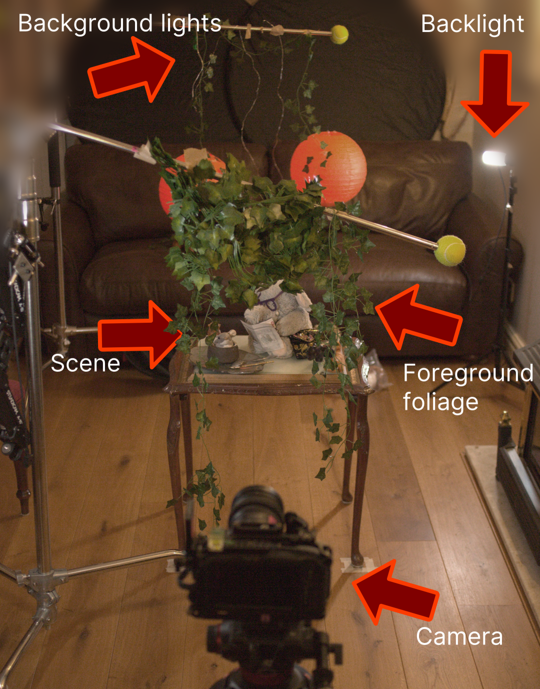
This photo shows how we did this for our video. We put some black cloth at the back to hide the living room curtains and then hung some paper lanterns and some fairy lights to make an attractive backgound. For the foreground, we hung some plastic ivy in front of the camera; if you have some cuttings from the garden, they could work great for this as well. We arranged Scabbers and Lavender on a small table in the middle of the room between these two layers.
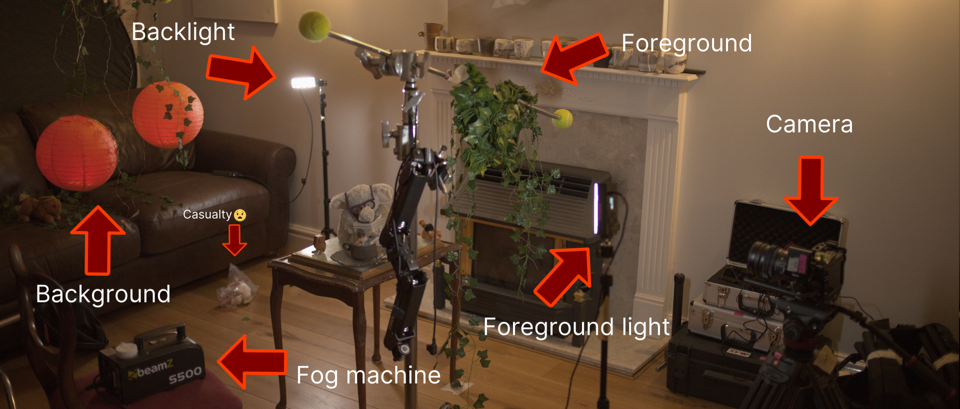
The camera can't tell that there are only these three layers, and so, with this simple setup, we've successfully hidden the living room and created a convincing scene
Keep the foreground and background out of focus
Now, we want the audience to believe that Scabbers and Lavender are in a Swanky members club. But, swanky clubs aren't usually decorated with old paper lanterns and cheap plastic ivy strands. We don't want our low-budget props to be giving the game away!
The trick here is to keep as much of these foreground and backgound elements out of focus as possible. We don't want the audience to focus on these background elements, so if we can keep them out of focus, while our characters are in focus, this will help draw the audiences attention to Lavender. That's one reason why these elements are often out of focus in films and, in our case, the blurriness also helps to hide the cheapness or imperfections of our decorations.
This was especially important for us, as we had a sofa in the back that we couldn't move. We don't want a giant sofa in our scene, but by keeping it in the dark and out of focus, you can't tell it's there.
The lights are the best example of this. We used the cheapest set of fairy lights you could find, and they'd already been used a bunch of times, so they were kind of mangled. But, just so long as they light up, out of focus lights look gorgeous, no matter how cheap they are.
If you are using a digital camera, you can achieve this out-of-focus effect by setting the aperture as wide as possible; if you see numbers on the camera like "f1.8", "f2", "f4" then you want to choose the lowest number possible; we used "f1.4" for our shot.
This is easier the larger your camera, as smaller cameras struggle to create this out-of-focus effect. Phones, in particular, traditionally haven't been the best for this. Some modern phones, however, have AI assistants that will detect the background elements and blur them out for you, simulating the effect that you would get with a larger camera.
Fog and haze
We love to see texture in images, and if an image is too clean and precise, it can feel artificial. Also, if we were in a real club, there would be dust in the air and steam from the kitchens and humidity in the air. We often don't notice these things, but we sometimes notice their absence and that can make the scene feel more like a photoshoot, than a real place.
One way to avoid this and add texture, is to use fog. Fog and haze in the atmosphere helps to make the scene feel much more real.
Sadly, fog is the one thing we can't really improvise from things we have lying around.
- Do NOT set fire to anything, not even paper, in an attempt to make smoke. Real smoke is bad for your health and you risk starting a fire.
- Do NOT try to use steam either; it doesn't hang in the air in the way that you want; it's not dense enough and boiling large quantities of water is dangerous!
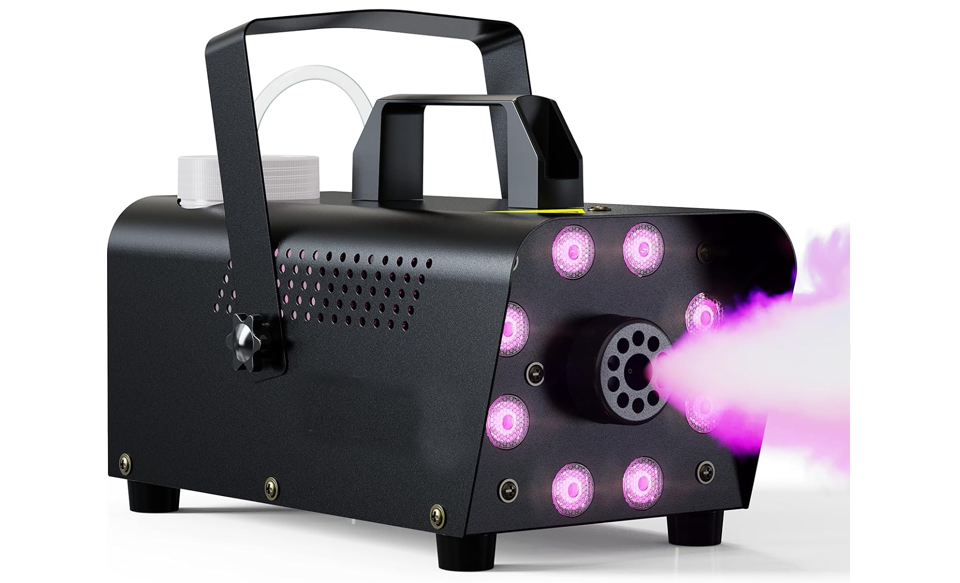
Fortunately, you can buy a cheap 500W fog machine, like the one in the picture, for £30-£40. You're not going to be fogging up an outdoor location with this little machine, but it's sufficient to fill your living room. We used exactly this kind of machine to make our scene.
Move the camera
When looking at a 2D picture, your eyes are much better at working out where things are in 3D space if things are moving. Because of this, we can increase the feeling of depth by moving the camera.
We chose to move the camera down to reveal our characters from behind the foliage that, we imagine, is decorating the ceiling of the club. As it happens, the fog that we added was hanging in the air in stratified layers, and these layers are much more visible as the camera moves through them, which adds even more texture to the image.
Most mobile phones have a stabalization mode that allows you to move the phone around without getting shaky footage. Some cameras have this as well; if yours doesn't, here are some simple ideas you could try:
- hold the camera on a skateboard or a rollerskate, or anything else that has wheels, and roll it along a table top.
- hold the camera tight against your chest and rock or move your body. Avoid taking steps and instead plant your feet so that you're well grounded.
- if you have a heavy enough tripod, fold it up with the camera still attached and try holding it at the balance point. You should find that it's easier to move the camera this way without shaking it.
Lights!
Besides what you choose to put in your scene, the second most important thing is lighting. Proper lighting can really make your shots look professional, but you don't need to use anything complicated or expensive.
- For the paper lanterns, you could use electric tealights; they are tiny, so add enough to get the brightness you need.
- Do NOT use candles; you will set fire to the lanterns!
- Fairy lights are cheap, and look gorgeous when they are out of focus in the background.
- You may already have a strip of RGB lights somewhere that might be fun to try.
- We used two Neewer TL96 RGB lights for the main lights. One at the back, backlighting the characters and picking out the haze, and one at the front to illuminate the folliage and provide some fill on the characers.
- The Neewer lights are inexpensive, and it's convenient to have adjustable RGB lights, but you could totally use normal lights that you have in the house. Try to use a daylight bulb, if possible, and diffuse the light through some tissue paper, or a muslin square or shower curtain to make it softer and more pleasing.
Here's another view of our setup from a different angle:
Over to you
Why not have a go and see what scenes you can create in your own living room? Could you create an environment like this for your next TikTok video?
If you'd like to learn more, why not join us for one of our holiday courses?